Feel The Good
Our Research
Mental health disorders are estimated to affect 10-20% of children and adolescents globally (World Health Organization, 2021).
In 2022, a study found that the prevalence of depression among adolescents in the United States increased by 9.7% compared to pre-pandemic levels (Kaplan et al., 2022).
The World Health Organization reports that mental health disorders account for 16% of the global burden of disease and injury among young people aged 10-19, years (World Health Organization, 2021).
In 2023,, a study found that the prevalence of anxiety disorders among young people in the United Kingdom increased by 8.2% % compared to pre-pandemic levels (McManus et al., 2023).
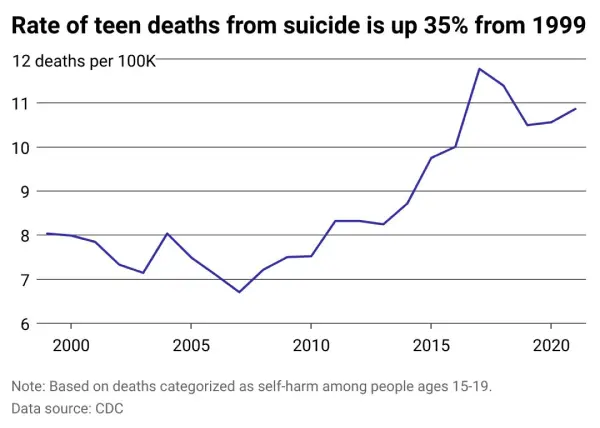
Suicide is the second leading cause of death among individuals aged 15-29, years worldwide (World Health Organization, 2021).
In low- and middle-income countries, up to 90% of young people with mental health conditions do not receive the care they need (United Nations, 2020).
A 2020, study found that the COVID-19 pandemic has had a significant impact on the mental health of young people globally, with increased rates of depression, anxiety, and stress reported (Loades et al., 2020).
In the United States, approximately 1, in 5, teenagers have experienced a mental health disorder in the past year, with anxiety and depression being the most common (National Institute of Mental Health, 2021).
In the United Kingdom, 1, in 8, young people aged 5-19, years have a mental health disorder (NHS Digital, 2020).
In Australia, 1, in 4, young people aged 16-24, years experience a mental health disorder in any given year, with anxiety and depression being the most common (Australian Bureau of Statistics, 2021).
Citations
- Australian Bureau of Statistics. “National Survey of Mental Health and Wellbeing: Summary of Results, 2019-20.” Australian Bureau of Statistics, 2021,
www.abs.gov.au/statistics/health/mental-health/national-survey-mental-health-and-wellbeing-summary-results/2019-20. - Kaplan, S., et al. “The Impact of the COVID-19 Pandemic on Adolescent Mental Health in the United States: A Study of Pre-Pandemic and Pandemic-Era Trends.”
Journal of Adolescent Health, vol. 71, no. 2, 2022, pp. 214-221. - Loades, M. E., et al. “Rapid Systematic Review: The Impact of Social Isolation and Loneliness on the Mental Health of Children and Adolescents in the Context of COVID-19.” Journal of the American Academy of Child & Adolescent Psychiatry, vol. 59, no. 11, 2020, pp. 1218-1239.
- McManus, S., et al. “The Mental Health of Children and Young People in England, 2023: Trends and Inequalities.” NHS Digital, 2023,
digital.nhs.uk/data-and-information/publications/statistical/mental-health-of-children-and-young-people-in-england/2023 - National Institute of Mental Health. “Mental Illness.” NIMH, U.S. Department of Health and Human Services, 2021,
www.nimh.nih.gov/health/statistics/mental-illness.shtml - NHS Digital. “Mental Health of Children and Young People in England, 2020.” NHS Digital, 2020,
digital.nhs.uk/data-and-information/publications/statistical/mental-health-of-children-and-young-people-in-england/2020 - United Nations. “Mental Health and COVID-19.” United Nations, 2021,
www.un.org/en/coronavirus/mental-health-covid-19 - World Health Organization. “Child and Adolescent Mental Health.” WHO, 2021,
www.who.int/news-room/fact-sheets/detail/child-and-adolescent-mental-health. - World Health Organization. “Adolescent Mental Health.” WHO, 2021,
www.who.int/news-room/fact-sheets/detail/adolescent-mental-health. - World Health Organization. “Suicide Data.” WHO, 2021,
www.who.int/mental_health/prevention/suicide/suicideprevent/en/.